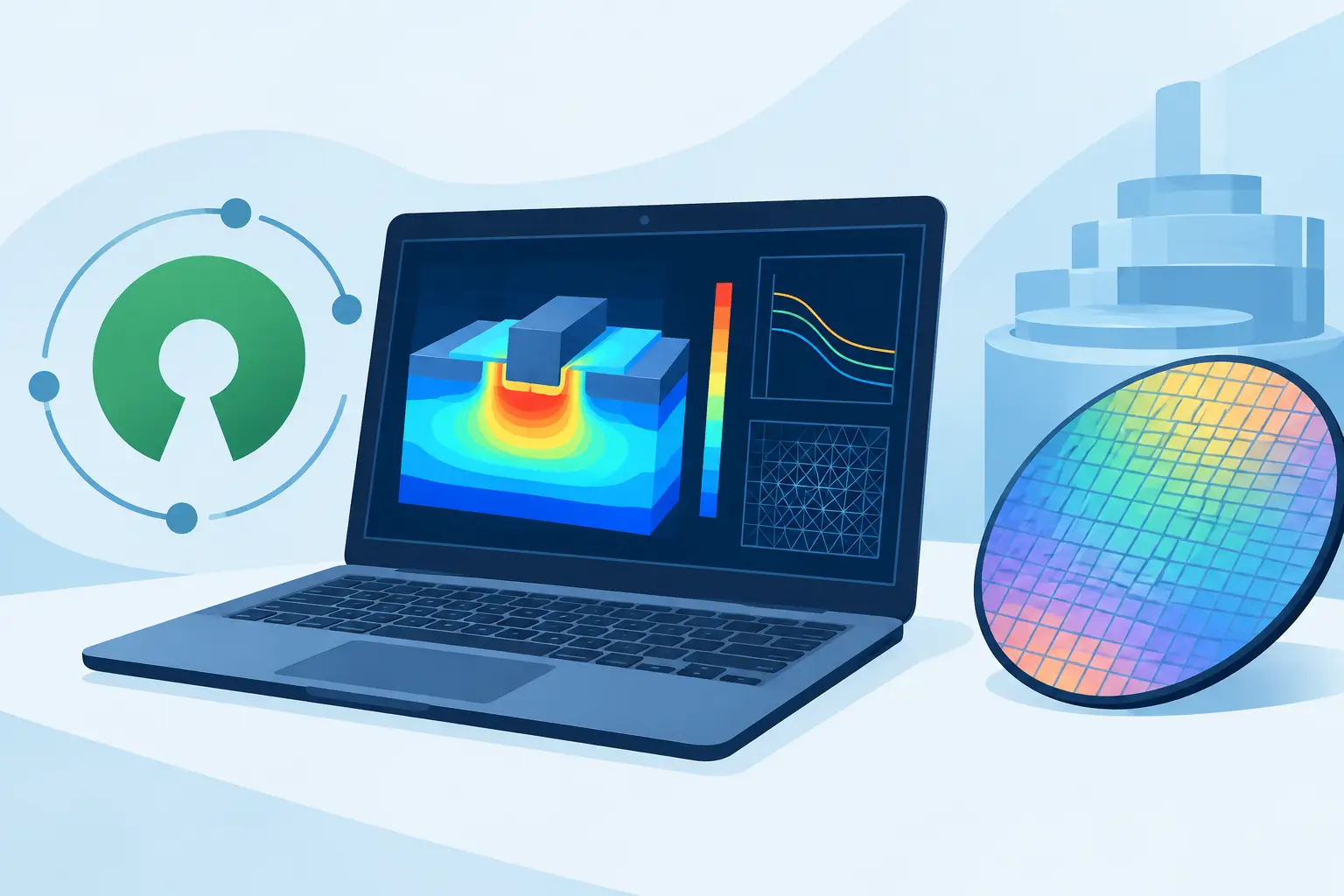
A simulated diode can produce a plausible I-V curve long before it produces a result suitable for a process decision. That distinction is central to evaluating open source TCAD. Source availability can be highly valuable for research, instruction, and custom model development, but it does not by itself establish numerical accuracy, model coverage, or a repeatable engineering workflow.
For semiconductor engineers, the question is not whether open-source software is inherently better or worse than licensed software. The practical question is whether a particular tool can represent the required physics, solve the specified geometry and mesh reliably, and produce results that can be checked against measured data or established reference cases.
Where Open Source TCAD Fits
Open-source TCAD commonly serves work where transparency and modification are primary requirements. A university group developing a new mobility formulation, for example, may need to inspect the discretization, add a material model, or couple a device solver to an external optimization routine. A research project with a narrow physical scope can justify the engineering effort required to assemble and maintain such a workflow.
It is also useful for instruction. Students can learn how Poisson, continuity, diffusion, and drift-current equations are formulated and discretized rather than treating simulation as a black box. For a device-physics course, a limited toolchain may be entirely appropriate when the objective is to examine depletion regions, carrier profiles, junction behavior, or the effect of doping on a basic structure.
Reproducible research is another legitimate use case. When a publication depends on a modified transport model or a new numerical method, access to source code can make assumptions easier to document and review. That benefit is meaningful only when the complete calculation is reproducible, including mesh construction, material parameters, boundary conditions, solver settings, and post-processing scripts.
Open source is therefore not a single category of capability. It may describe a device solver, a mesh generator, a finite-element library, a visualization package, or a collection of scripts assembled into a simulation flow. Teams should distinguish between access to a code base and access to a maintained, validated TCAD environment.
The Technical Questions Behind an Open Source TCAD Choice
A useful evaluation starts with the engineering problem, not with the licensing model. A planar silicon device under steady-state bias has different requirements from a process simulation involving oxidation and dopant diffusion. Both differ again from a three-dimensional thermal problem involving irregular geometry, material interfaces, and a mesh containing hundreds of thousands or more nodes.
Physical Models Must Match the Device
The first requirement is model scope. A solver may handle Poisson and electron-hole continuity equations while omitting effects that matter to the target device. Depending on the application, those effects can include incomplete ionization, Fermi-Dirac statistics, concentration-dependent mobility, high-field transport, recombination mechanisms, impact ionization, tunneling, quantum corrections, or self-heating.
The correct model set depends on the operating regime. A model that is sufficient for a low-voltage silicon p-n junction may not be sufficient for a power device, a scaled MOS structure, a compound semiconductor, or a device operating over a broad temperature range. Adding a model is not automatically an improvement, either. Each model introduces parameters, assumptions, and possible calibration requirements.
Process and device simulation must also connect cleanly when the objective is fabrication-aware analysis. A device solver needs a credible representation of dopant distribution, material boundaries, and geometry. If a team must move diffusion profiles manually between unrelated tools, it should account for interpolation errors, coordinate conventions, and the time required to verify every transfer.
Numerical Behavior Is Part of the Result
A physically complete equation set is not sufficient if the numerical method is unstable, poorly conditioned, or difficult to converge for realistic bias conditions. Engineers should examine the discretization approach, nonlinear solver behavior, mesh controls, and available convergence diagnostics.
This matters most near strong gradients: depletion edges, heterojunctions, contact regions, narrow current paths, and thermal hotspots. Coarse meshes can smooth the very behavior under investigation. Excessive refinement, however, increases runtime and can expose weaknesses in matrix assembly or solution algorithms. A credible workflow needs mesh-convergence testing rather than a single visually convincing contour plot.
Boundary conditions deserve the same scrutiny. Ohmic and Schottky contacts, insulating surfaces, symmetry planes, thermal interfaces, and external circuit conditions can determine whether a solution has physical meaning. A tool that accepts a boundary-condition statement without warning is not necessarily treating it correctly.
Verification Is Different From Validation
Verification asks whether the equations are solved correctly. Validation asks whether the equations and parameters represent the physical device. Both are required for engineering use.
For verification, teams can use analytical limiting cases, manufactured solutions, conservation checks, and mesh-refinement studies. For validation, compare simulated junction depth, sheet resistance, capacitance-voltage behavior, I-V characteristics, temperature response, or thermal measurements with relevant data. A match at one bias point is weak evidence. A model should remain credible across the process conditions and operating range that drive the design decision.
This is where open-source projects vary substantially. Some provide published benchmarks, test suites, and well-defined examples. Others provide an effective starting point for research but leave validation entirely to the user. Neither situation is wrong, but they imply different staffing and project risk.
The Cost Is Usually Engineering Time
No license fee does not mean no cost. For a small exploratory calculation, an open-source tool may be the economical choice. For a development group that must produce repeatable results under schedule pressure, the larger cost can be the time spent integrating software, repairing dependencies, implementing missing models, investigating convergence failures, and documenting an internally supportable flow.
That cost is especially visible when the original developer leaves a research group or when a computing environment changes. A simulation deck may depend on a particular compiler, numerical library, operating-system version, or script collection that was never formalized. The result is often a tool that works for one expert and remains inaccessible to the rest of the organization.
Support also has a practical value. In semiconductor simulation, a questionable result may arise from physics assumptions, geometry, mesh quality, contact definitions, material parameters, or a genuine solver defect. A maintained product with clear specifications and technical support does not eliminate those questions, but it gives engineers a defined path for resolving them.
When a Standalone Licensed Tool Is the Better Fit
A licensed TCAD package is justified when the team needs a defined capability set, stable operation, documentation, and a workflow that does not require every user to become a numerical-methods developer. This is particularly relevant for process engineers and device designers who need to establish two-dimensional diffusion profiles, evaluate structures, or analyze electrical behavior without purchasing a broad enterprise suite.
The same principle applies to specialized three-dimensional field and thermal problems. Heat transfer, Poisson, diffusion, drift-current, and spreading-resistance calculations can require large meshes and careful treatment of geometry and material boundaries. At that point, the selection criterion should be demonstrated numerical capacity and the equations supported, not whether the software is distributed as source code.
Siborg Systems approaches this distinction through separate tools matched to the workload. MicroTec is intended for two-dimensional semiconductor process and device modeling, while SibLin addresses three-dimensional numerical problems involving heat transfer, electrostatics, diffusion, drift-current, and spreading resistance. The relevant comparison is not open source versus commercial as an abstract preference. It is whether the selected simulator addresses the physical problem with a supportable level of effort.
A Practical Evaluation Procedure
Before committing a project to an open-source flow, define a short acceptance study using a device or structure with known behavior. The study should be specific enough to expose limitations rather than merely confirm that the software launches.
- Specify the geometry, material system, operating range, and outputs required for the actual engineering decision.
- Identify the governing equations and physical models needed, including any temperature, high-field, or recombination effects.
- Run mesh-refinement and solver-tolerance studies to determine whether key outputs are numerically stable.
- Compare results with measured data, analytical cases, or trusted reference simulations across more than one operating condition.
- Record the full environment, input files, model parameters, and runtime needed for another engineer to reproduce the calculation.
This procedure applies equally to commercial tools. The difference is that an open-source implementation may require the user to create more of the surrounding infrastructure, including benchmarks, documentation, and support practices.
The best simulation environment is the one that makes the next engineering decision more defensible. If source access advances that goal, it is a legitimate advantage. If the work instead depends on verified models, controlled workflows, and reliable turnaround, choose the simulator that matches the problem rather than the licensing label.
Leave a Reply